

Quick Answer: Brand strategy is the plan behind a brand: who it serves, what it stands for, and how it competes. Brand identity is the visible and verbal expression of that plan, including the logo, colors, typography, and tone of voice. Most businesses need strategy first, because an identity built without one looks finished but has nothing specific to say.
A new logo goes live, the website gets a fresh coat of color, and six months later the leads look exactly the same as before.
The design usually isn't the problem. Nobody decided what the design was supposed to communicate, to whom, or why a buyer should pick this business over the three others in the same search results.
That gap tends to get paid for twice: once for the original design, and again for the rebrand that tries to fix it a year later.
This guide breaks down what separates the two, the pillars and elements behind a working brand strategy, what a brand identity actually requires, and how a business can tell which one it needs right now.
Quick Summary: Brand Identity vs Brand Strategy Explained
| Brand strategy | The plan: purpose, audience, positioning, values, and personality |
|---|---|
| Brand identity | The expression: logo, color palette, typography, imagery, and tone of voice |
| Which comes first | Strategy in most cases, since identity decisions need a brief to answer to |
| 5 pillars | Purpose, vision, values, personality, and positioning |
| 7 elements | Purpose, consistency, emotion, flexibility, employee involvement, loyalty, and competitive awareness |
| Why consistency matters | A 2019 Lucidpress study linked consistent branding to revenue gains of up to 33% |
| Typical timeline | A focused brand sprint covering both can run in about four weeks |
What Is the Difference Between Brand Identity and Brand Strategy?
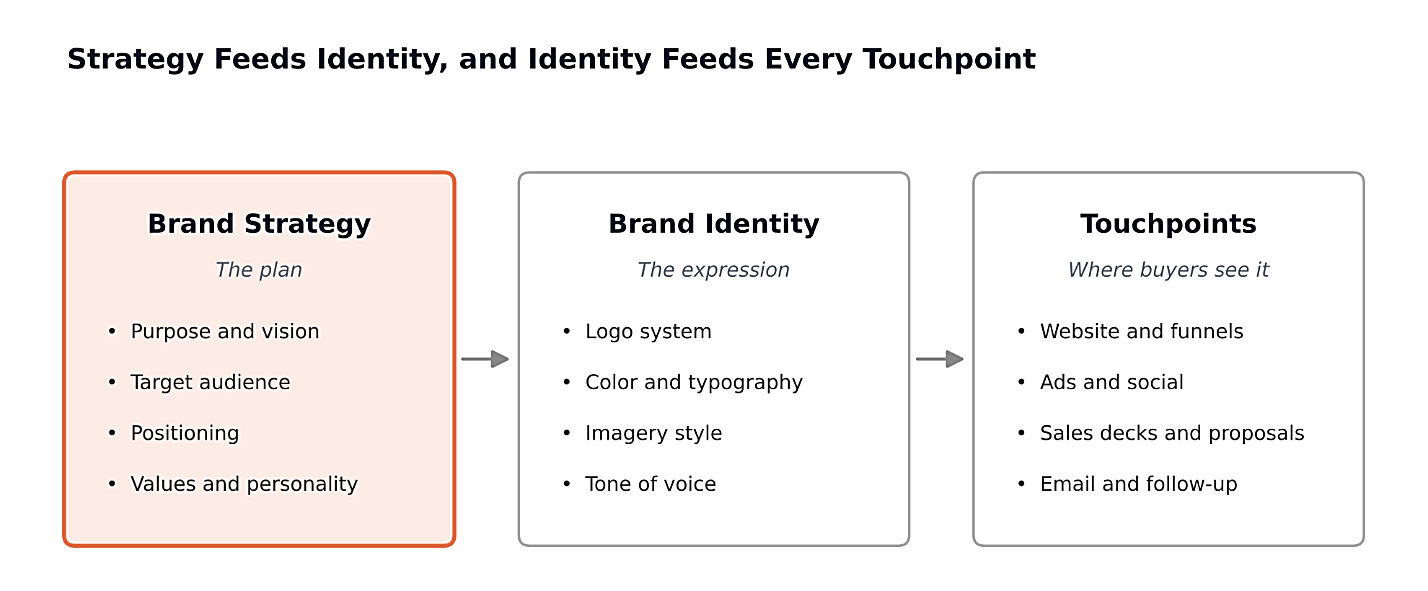
Brand strategy is the decision layer. It defines who the business serves, what problem it solves better than the alternatives, what it believes, and how it should sound when it speaks.
Brand identity is the expression layer. It turns those decisions into things people can see and hear: a logo system, a color palette, typography, a photography style, and one consistent voice across every channel.
Put simply, strategy decides what the brand should mean, and identity makes that meaning recognizable. Each one fails in a predictable way without the other.
| Aspect | Brand Strategy | Brand Identity |
|---|---|---|
| Core question | Why does this brand exist, and for whom? | How will people recognize it? |
| Main outputs | Positioning statement, audience profile, values, messaging pillars | Logo system, color palette, typography, imagery, voice guide |
| Who builds it | Leadership working with a strategist | Designers and copywriters, working from the strategy |
| How long it lasts | Years, revisited when the market or offer shifts | Refreshed more often as channels and formats change |
| Failure without the other | A clear plan nobody can see or remember | A polished look with nothing distinct to say |
| How it shows up in results | Win rate, pricing power, lead quality | Recognition, consistency, trust at first contact |
What Are the 5 Pillars of Brand Strategy?
There is no single official list. Agencies name the five pillars in slightly different ways, but most versions come back to the same foundation:
Purpose: why the business exists beyond revenue, stated in a sentence a customer would actually believe.
Vision: where the brand intends to be in five to ten years, which keeps short-term decisions pointed somewhere.
Values: the few principles the business won't trade away, even when holding them costs a sale.
Personality: the human character of the brand, which later shapes its tone of voice and visual style.
Positioning: the specific place the brand holds in a buyer's mind compared with the alternatives.
Some versions swap vision and values for perception and promotion, which tilts the list toward marketing rather than foundation. The core idea stays the same either way.
Positioning carries the most commercial weight of the five, because it decides which buyers a brand attracts and whether it competes on value or on price. The three questions behind a sharp category position are covered in Funnel Gator's breakdown of B2B brand positioning.
What Are the 7 Key Elements of Brand Strategy to Follow: Quick Overview
Where the five pillars describe what a brand is built on, the seven elements describe how a strategy behaves once it's live in the market. The most widely cited version of this list comes from HubSpot:
Purpose: the reason the brand exists, which every other element points back to.
Consistency: the same message and look across the website, ads, sales calls, and invoices.
Emotion: a reason for buyers to feel something about the brand, not just understand it.
Flexibility: room to adapt campaigns to trends without breaking the core identity.
Employee involvement: staff who can explain and represent the brand without a script.
Loyalty: deliberate rewards for existing customers, who already chose the brand once.
Competitive awareness: a clear read of what rivals do well, so the brand avoids sounding like them.
Consistency is the element that connects strategy to identity most directly. A brand can have a sharp strategy on paper and still look like three different companies across its website, social profiles, and sales decks.
Strategy or Identity First? How to Decide What a Business Needs
This is the question that decides where a branding budget actually goes, and the answer depends on what a business already has in place.
The short answer: strategy first, unless a working strategy already exists
Identity decisions need a brief to answer. A designer choosing between a bold, high-contrast palette and a quiet, minimal one is really choosing a personality, and that choice belongs to strategy.
A business with a clear audience, positioning, and voice may only need an identity refresh. A business that can't describe who it serves in one sentence won't fix that with new visuals.
Signs a business needs brand strategy first
These signs usually point to a strategy gap rather than a design one:
Sales conversations start with price because buyers can't see a difference
The team describes the business differently depending on who is asked
Marketing attracts leads who are a poor fit for the core offer
A recent redesign changed the look but not the results
Signs a business only needs a brand identity refresh
An identity project on its own makes sense when the foundation is already solid:
Positioning is clear and still accurate for the current market
The logo and visuals look dated next to newer competitors
Assets are inconsistent across channels, with no guidelines to follow
The business is moving into a new channel, such as paid social, that needs new formats
What this looks like for a service business
In our experience working with service businesses, the strategy gap usually shows up in the funnel before anyone notices it in the brand. Landing pages convert poorly because the headline could belong to any competitor.
Once that message is fixed, identity work starts paying off, because the visuals finally have something specific to reinforce.
Key Takeaway: A new identity amplifies whatever strategy sits underneath it. If the strategy is vague, a better-looking brand just makes the vagueness more visible.
What Do You Need for a Brand Identity: A Complete Kit Checklist
A complete brand identity is a system, not a logo. A business needs these working parts before it can apply the brand consistently:
Logo system: a primary logo, secondary versions, and an icon for small spaces
Color palette: exact values for both print and screen
Typography: one or two typefaces with rules for headings and body text
Imagery style: guidance for photography, illustration, and icons
Tone of voice: how the brand sounds, with words to use and words to avoid
Brand guidelines: one document that records all of the above
Core templates: ready-made layouts for the assets the team produces most often
Guidelines are the piece most often skipped and the one that protects the investment. Without them, every new hire, freelancer, and agency reinterprets the brand from scratch.
Pro Tip: Before commissioning a new identity, collect every asset currently in use: the website, social headers, proposals, email signatures, and ads. Laying them side by side exposes consistency gaps faster than any audit questionnaire.
Brand Identity Services vs Brand Design Services: Quick Comparison
The two terms get used interchangeably, but they usually describe different scopes of work. Knowing the difference keeps a business from paying for the wrong project.
Brand identity services typically cover the strategic groundwork plus the full visual and verbal system. Brand design services usually apply an existing identity to specific assets, such as a website, social graphics, packaging, or a pitch deck.
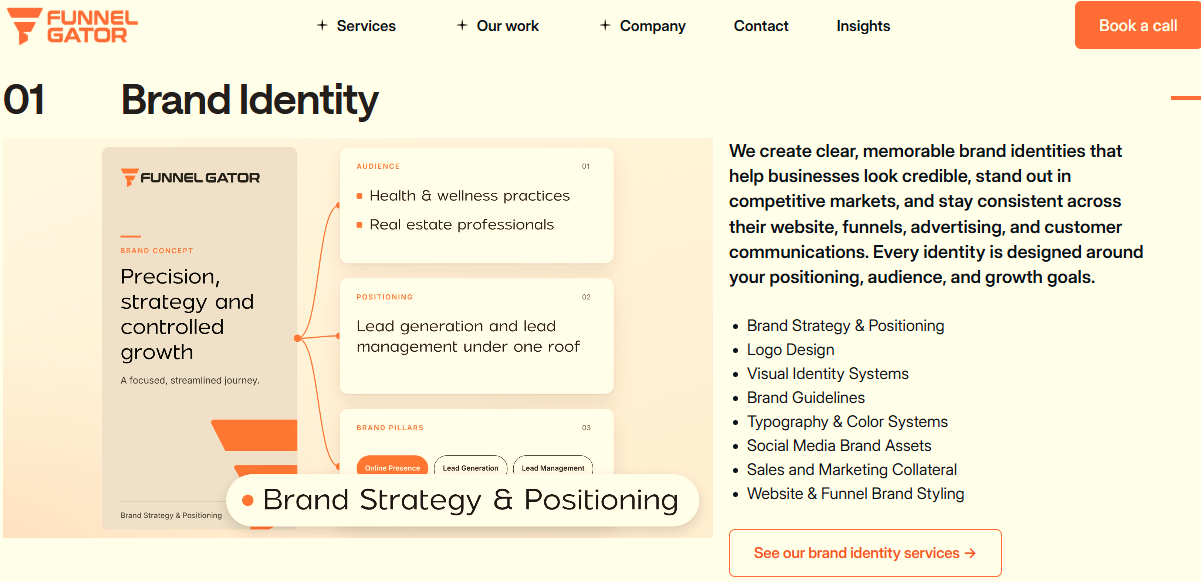
Funnel Gator's brand identity services run as a four-week sprint: discovery and strategy direction in week one, identity concepts in week two, the logo system, color, typography, and guidelines in week three, and final files in week four.
One client, Moab Reservation Center, described the result as a brand identity that “finally feels consistent everywhere customers see us.”
What Brand Consistency Is Actually Worth
Consistency is where strategy and identity pay off together, and it's one of the few parts of branding with survey data behind it.
Lucidpress's 2019 State of Brand Consistency report, based on a survey of more than 200 organizations, found that consistent branding can increase revenue by up to 33%. The same study found 81% of companies still deal with off-brand content.
One limitation: that 33% figure is a ceiling from a vendor survey, and Lucidpress sells brand template software. It works as direction, not as a forecast for any single business.
The Risk of Rebranding Without a Strategy
Trust is the real cost of getting this wrong. In Edelman's 2019 Trust Barometer special report, an eight-country study, 81% of consumers said being able to trust a brand to do what is right was a deciding factor in buying from it.
A rebrand that changes the look without a clear reason confuses existing customers and resets recognition the business spent years building. Buyers who aren't sure they're dealing with the same company tend to hesitate.
Founders often feel the pull to redesign when growth stalls, because a new look feels like visible progress. It's an understandable instinct, and an expensive one when the real issue sits in the positioning.
⚠ Warning: Avoid launching a new identity in the middle of an active ad campaign or sales push. Changing visuals mid-flight breaks recognition with warm prospects and makes it impossible to tell whether results moved because of the brand or the timing.
Who This Guide Is For (and Who It Isn't)
This guide fits founders and marketing leads at small and mid-sized service businesses deciding where to spend a limited branding budget, especially those whose marketing brings in leads that are hard to convert at a healthy price.
It's less useful for large enterprises with an in-house brand team and established governance, or for a business whose core offer is likely to change within the next few months.
Not Sure Whether Your Brand Needs Strategy or a New Look? Book a Free Strategy Call
Funnel Gator will review the current brand and show where the gap actually sits before any design work starts.
A review of positioning, messaging, and visual consistency across every channel
A clear recommendation on strategy, identity, or both
A four-week sprint plan if a full brand build makes sense
No payment, no pressure, just a plan.
Final Verdict: Strategy Sets the Direction, Identity Makes It Visible
Brand identity vs brand strategy isn't a choice between two options so much as a question of order. Strategy decides who the business serves, what it stands for, and why a buyer should choose it; identity makes those decisions recognizable at every touchpoint. A business with a clear position and a dated look needs an identity refresh. A business with a sharp look and leads that convert poorly at the wrong price usually needs strategy first. Either way, the work should end with guidelines the whole team can follow, because consistency is where the return shows up. Funnel Gator builds both layers for service businesses, then connects the finished brand to the funnels and follow-up systems that turn recognition into booked calls.