
Quick Answer: To create a brand identity, a business first locks its strategy (audience, positioning, personality), then audits its current brand and competitors, secures a name, builds a visual system and a verbal voice, documents both in brand guidelines, and rolls the result out consistently across every touchpoint. Recognition comes from repetition: the same look and voice, applied the same way, for long enough that buyers start to know the brand on sight.
A buyer lands on a service business's website, then checks its Instagram, then opens a proposal PDF. Three touchpoints, three different-looking companies.
Nobody says anything about it. The buyer just trusts the business a little less, and picks the competitor whose website, social feed, and proposal all clearly came from the same place.
That's the quiet cost of an identity built piece by piece: a logo from one freelancer, a website from a template, social graphics made in whatever colors were handy that week.
This guide walks through the full build, from strategy and naming to the visual system, voice, guidelines, and rollout, along with how to present a finished identity and when a rebrand is worth the risk.
Quick Summary: How to Create Brand Identity Explained
| Start point | Strategy first: audience, positioning, and personality decide every design choice |
|---|---|
| Core steps | Strategy, audit, naming, visual system, voice, guidelines, rollout |
| Key attributes | Distinctive, consistent, flexible, memorable, accessible, and legally protectable |
| Why it pays | A 2015 Nielsen survey found 59% of consumers prefer buying new products from brands they know |
| Accessibility | WCAG sets a 4.5:1 minimum contrast ratio for normal body text |
| Naming risk | The USPTO advises a clearance search before applying to register a trademark |
| Timeline | A focused brand sprint can deliver a full identity system in about four weeks |
Branding vs Brand Identity: Where Identity Fits
The terms get swapped constantly, which is how businesses end up paying for a logo when they needed a system. Each one describes a different thing.
Brand identity is the toolkit: the name, logo, colors, typography, imagery, and voice a business controls directly. Branding is the ongoing work of using that toolkit to shape how people see the business.
The brand itself is the result: what buyers actually think and feel. A business can't control its brand directly, only the identity and the branding that influence it.
| Term | What it is | Who controls it | Example |
|---|---|---|---|
| Brand | The perception buyers hold about the business | The market | “The agency that actually answers the phone” |
| Branding | The ongoing activity of shaping that perception | The business, over time | Posting, campaigns, sales calls, service quality |
| Brand identity | The visible and verbal toolkit | The business, directly | Logo, palette, type, imagery, voice |
| Brand strategy | The plan the identity expresses | Leadership | Audience, positioning, values, personality |
The Attributes of a Strong Brand Identity
Before building anything, it helps to know what a finished identity should be able to do. Strong identities share six attributes:
Distinctive: it can't be mistaken for a competitor, even with the name covered.
Consistent: it looks and sounds the same on a billboard, a proposal, and an Instagram story.
Flexible: it works at favicon size and on a trade show banner without falling apart.
Memorable: a buyer can recall at least one element, a color, a shape, a phrase, after one exposure.
Accessible: people with low vision or color blindness can read it.
Protectable: the name and mark can legally belong to the business.
Accessibility is the attribute most brand guides skip. The WCAG contrast standard published by the W3C sets a minimum contrast ratio of 4.5:1 for normal text and 3:1 for large text, so a palette should be tested against it before anything is printed.
How to Create Brand Identity in 7 Simple Steps
The order matters more than any single step. Each one produces the input the next step needs, which is why skipping ahead to the logo is the most common and most expensive mistake.
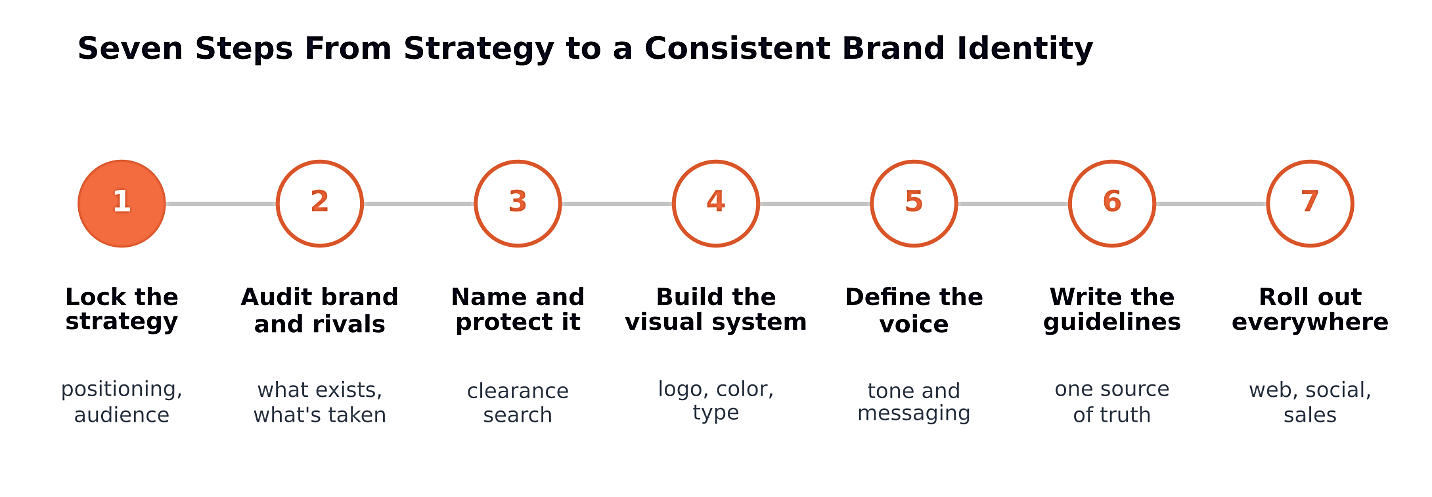
Step 1: Lock the Strategy Before Any Design
Brand strategy design starts with three decisions: who the business serves, what it does better than the alternatives, and what personality it should project. Without them, every design review turns into a debate about taste.
Positioning is the decision that shapes the most design choices, since a premium position and a value position call for very different visuals. Funnel Gator's guide to B2B brand positioning covers the three questions that define it.
Step 2: Audit the Current Brand and the Competition
Collect every asset already in use, then pull the identities of the five closest competitors. The goal is to see what already exists, what is working, and which colors, shapes, and phrases are already taken in the category.
What to collect in the audit
Website, social profile headers, and the last 20 social posts
Proposals, invoices, email signatures, and sales decks
Competitors' logos, primary colors, and homepage headlines
Reviews and testimonials, for the words customers actually use
Lay the competitor identities side by side and note the patterns. If four out of five rivals use navy and a plain sans serif wordmark, that combination signals the category, and a business that copies it will blend in rather than stand out.
Step 3: Settle the Name and Make Sure It Can Be Protected
Corporate identity and naming sit together because the name is the one identity element that is hardest to change later. A good name is easy to say, easy to spell after hearing it once, and available as a domain and social handle.
Most service business names fall into four types: descriptive, founder-based, invented, or metaphorical. Descriptive names are understood on day one but are harder to protect, while invented names are easier to protect but take more marketing to build meaning.
Availability matters as much as appeal. A name that conflicts with an existing trademark in the same industry can force a full rebrand after the business has already paid for a logo, signage, and a website.
Step 4: Build the Visual System
The visual system turns the strategy into things people can see. It covers four working parts, and each one needs rules, not just a file.
Logo system
A logo system includes a primary logo, a simplified secondary version, and an icon that still reads at 32 pixels. Each version needs light and dark variants.
Color, typography, and imagery
Most strong palettes use one or two primary colors, a neutral, and an accent. Typography usually needs one typeface for headings and one for body text, plus a clear direction for photography and illustration.
Accessibility check before sign-off
Every text and background color pairing in the palette should be tested for contrast before the guidelines are written. Fixing a failing color after launch means reprinting and redesigning everything that used it.
Step 5: Define the Verbal Identity
Voice is the half of identity that most small businesses never write down. It includes the tone, words the brand always uses, words it avoids, a one-line positioning statement, and a short tagline if one fits.
A useful test: a customer should be able to tell a brand's email came from that brand even with the logo removed.
Voice guidance works best as contrasts rather than single adjectives. “Confident, not arrogant” or “plain-spoken, not casual” gives a writer something to check a draft against; a word like “friendly” on its own does not.
Step 6: Document Everything in Brand Guidelines
Guidelines are the single source of truth that keeps the identity intact after the designers leave. They should cover logo usage and clear space, exact color values, type rules, imagery direction, voice, and real examples of right and wrong use.
Guidelines don't need to be long to work. The pages teams use most are the ones showing real examples of correct and incorrect use, so those deserve more space than the brand history.
Step 7: Roll Out Across Every Touchpoint, Starting With Social
Social media is usually where consistency breaks first, because it produces the most content with the least review. A consistent aesthetic across social branding and visual identity comes from templates, not willpower.
Build three to five post templates, a fixed set of colors and fonts for stories, and one profile image and header used everywhere. Then roll out to the website, sales materials, and email in order of traffic.
For most service businesses, that order means the website and Google Business Profile first, then social profiles, then proposals and email templates, and printed materials last, once the digital versions have been tested with real buyers.
Key Takeaway: Recognition comes from repetition, not from the logo itself. A simple identity applied the same way for two years builds more recognition than a brilliant one applied inconsistently.
How to Present a Brand Identity and What You Need to Know
A brand identity presentation decides whether stakeholders approve the work or pick it apart. The strongest ones show branding in use, not logos floating on white backgrounds.
Open with the strategy: remind the room who the brand serves and what it needs to communicate.
Show the system, then the logo: palette, type, and voice first, so the logo reads as part of a whole.
Show branding in context: mockups of the website, a social post, a proposal cover, and signage.
Tie each choice to the strategy: every color and typeface should have a reason the room can repeat.
A brand identity portfolio follows the same logic. Designers and agencies building a portfolio case study should show the problem, the strategy, the system, and the identity applied across real touchpoints, rather than a single logo slide.For a practical example, explore the Moab Reservation Center case study to see a brand identity project in context.
Keeping a Brand Identity Consistent Over the Long Term
A long term branding strategy is mostly governance. Identities rarely fail at launch; they erode over the following year as new hires, freelancers, and agencies each make small exceptions.
This is also where brand tactics and brand strategy separate. Tactics are the individual campaigns, posts, and promotions; strategy is the set of rules every tactic has to follow, so campaigns can change while the identity stays put.
Assign one owner for the guidelines, with approval rights over new assets
Run a short consistency audit every quarter using the same asset checklist from Step 2
Keep templates in one shared library so nobody rebuilds from scratch
Review the identity against the strategy once a year, not every time a campaign underperforms
Pro Tip: Add the brand guidelines link to every freelancer and agency brief by default. Most inconsistency comes from people who never saw the guidelines, not people who ignored them.
When Rebranding Makes Sense and When It Backfires
Rebranding resets recognition the business has spent years building, so it needs a reason stronger than boredom with the current look. Good reasons include a merger, a major change in the offer or audience, a name conflict, or an identity that genuinely can't scale.
Founders often feel the pull to rebrand when growth slows, because a new look feels like visible progress. It's an understandable instinct, and a costly one when the real problem sits in the offer or the follow-up process.
A name change carries its own legal risk. The USPTO's guidance on why to search for similar trademarks advises running a clearance search before applying to register a mark, since a likelihood of confusion with an existing mark can block registration.
⚠ Warning: Never commit to signage, printed materials, or a domain before the name has cleared a trademark search. A rebrand forced by a conflict after launch costs far more than the original identity did.
Brand Development Services: What to Expect From a Partner
Brand development services cover the full build described above, from strategy and naming through the visual system and guidelines. Brand development and management services add the ongoing governance: audits, new templates, and approval of new assets after launch.
Funnel Gator's brand identity services run the build as a four-week sprint: brand discovery and strategy direction, identity concepts, the logo system with color, type, and guidelines, and a final brand asset library.
In our experience, the businesses that get the most from a brand build are the ones that roll it straight into their website, funnels, and sales materials, rather than saving it for a big launch day that keeps slipping.
One honest limitation: there's no audited, industry-wide figure for how much a new identity alone lifts conversion rates. Results depend on how consistently the identity is applied after launch.
Does the Same Process Work for Personal Branding: Quick Overview
Yes, at a smaller scale. Founders, consultants, and practitioners follow the same steps, with the person standing in for the company. Five reasons personal branding is important for service businesses in particular:
Trust transfers: buyers often trust a visible founder before they trust a company name.
Referrals travel further: a person is easier to recommend than a logo.
Content performs differently: a founder's posts read as opinion, not advertising.
Hiring gets easier: candidates research the people they will work for.
It survives a rebrand: a personal reputation carries over if the company name changes.
The rules still apply: one consistent headshot, color palette, and tone across every profile, documented so a founder's team can post on their behalf without drifting.
Who This Guide Is For (and Who It Isn't)
This guide fits founders and marketing leads at small and mid-sized service businesses building an identity for the first time, or replacing one that was assembled piece by piece over the years.
It's less useful for enterprises managing a portfolio of sub-brands, where brand architecture and global governance need their own process, or for a business still testing whether its offer has a market at all.
Ready to Build a Brand Identity Buyers Recognize? Book a Free Strategy Call
Funnel Gator will review the current brand across every touchpoint and map out what a full identity build would include.
A consistency audit of the website, social profiles, and sales materials
A clear plan for strategy, naming, visuals, and voice
A four-week sprint timeline with the deliverables listed upfront
No payment, no pressure, just a plan.
Final Verdict: Consistency Turns an Identity Into Recognition
Learning how to create brand identity comes down to order and discipline. Lock the strategy, audit what exists, secure a name that can be protected, then build the visual system and voice and write them into guidelines the whole team can follow. Recognition doesn't come from a clever logo; it comes from showing buyers the same look and voice on every touchpoint for long enough that they start to trust it. Treat the rollout and the governance as part of the build, not an afterthought, and the identity keeps paying off long after launch. Funnel Gator builds brand identities for service businesses and connects them to the websites, funnels, and follow-up systems that turn recognition into booked calls.