
Quick Answer: What is a lead management system? It is software plus written rules that capture every inquiry, qualify it, route it to a named owner, follow up and track the result to a sale. HubSpot's 2026 guide puts the split with a CRM in one line: "A CRM provides structure; lead management provides motion."
A business has a CRM, a spreadsheet and two inboxes, and each one holds a different version of the same lead.
The contacts exist, but nobody can say which record is current or who is meant to reply.
Buying another tool does not fix that, because the gap is not storage.
A lead management system supplies the missing layer: an owner, a response rule and a next step on every record.
In this guide you will explore the meaning and purpose of how a system differs from a CRM, the five stages, why a system matters, what drives cost, when services beat software alone, who can wait and what to check about data.
| Quick Summary: What Is a Lead Management System | |
|---|---|
| Definition | Software and rules that capture, qualify, route, follow up on and track every inquiry. |
| Purpose | Convert more of the inquiries already paid for, not create new ones. |
| Versus CRM | A CRM stores lead data. A system moves each lead through stages with owners and time limits. |
| Five stages | Capture, qualify and score, route, nurture, track and convert (HubSpot, 2026). |
| Why now | B2B customers regularly use ten or more channels, up from five in 2016 (McKinsey, 2021). |
| Cost | No approved benchmark sets a price. Software, setup, volume and upgrades drive it. |
What is a lead management system, and what is its purpose in marketing?
The term covers everything that happens to an inquiry after it exists.A lead management system captures, qualifies, routes and tracks every inquiry in one place
What is lead management at its simplest? Log each inquiry, judge whether it fits, assign an owner, answer it, and measure the outcome. A system does those five jobs with software and written rules instead of memory and shared inboxes. Funnel Gator's lead management services build that system in four weeks: a lead audit, lead mapping, system setup and optimization.The purpose is to convert more of the inquiries already paid for, not to create new ones
Lead management purpose comes down to one result: fewer leads lost between the first inquiry and the first conversation. Marketing creates inquiries through ads, search, and referrals, and a lead management system handles each one afterward. The outcome is measured in booked appointments and closed jobs, not in lead counts.How does a lead management system differ from a CRM, and is lead management part of CRM?
Two 2026 guides draw the same line from different sides.A CRM stores lead data, and a lead management system adds the rules that move each lead forward
HubSpot's 2026 guide says a CRM stores customer and company data, and that lead management builds on it by using that data to move prospects through the sales process. Zapier's 2026 guide calls a CRM the software where lead data and sales interactions are stored, and lead management the workflow that moves buyers down the funnel. That is the core of a lead management system vs CRM: one holds records, the other decides what happens to them.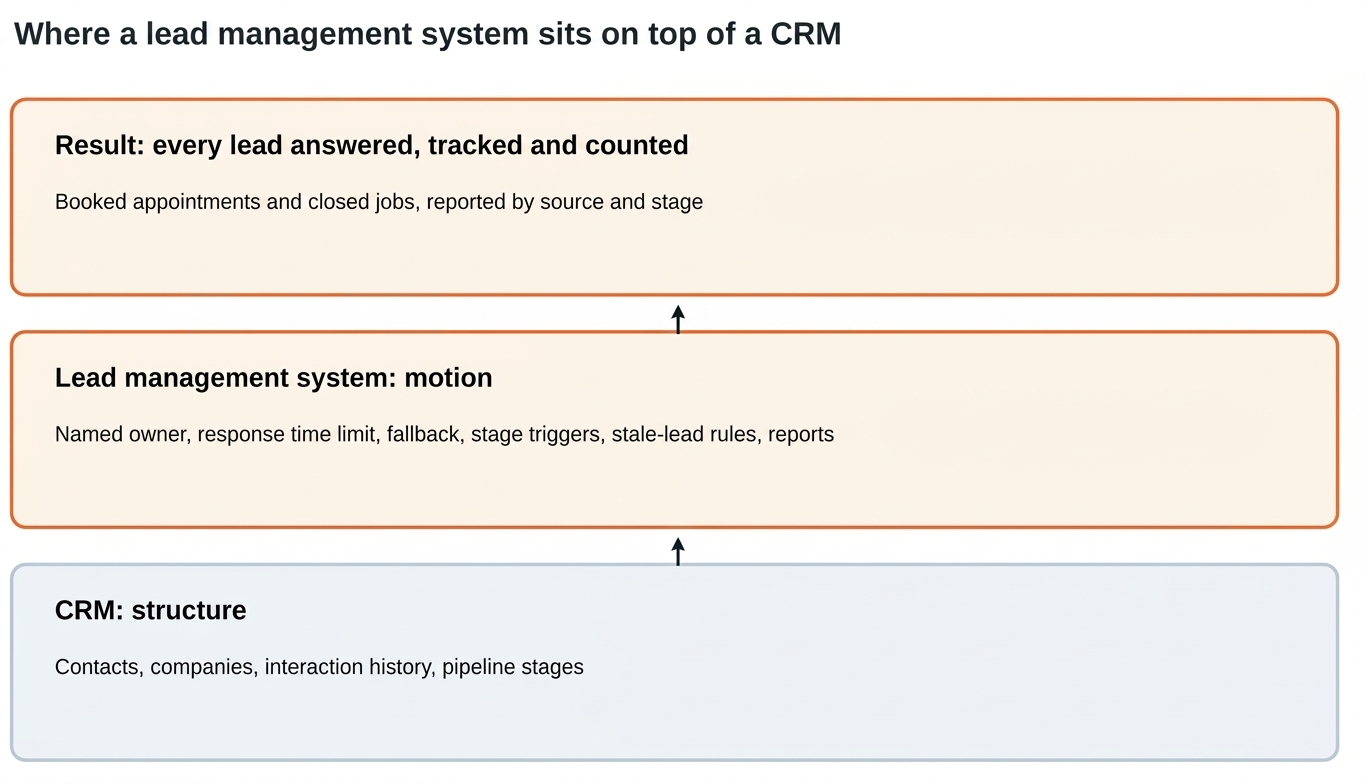
| Lead management system compared with a CRM | ||
|---|---|---|
| Question | CRM alone | Lead management system |
| What it holds | Contacts, companies and interaction history | The same records, plus owner, stage and next step |
| Who replies first | Not decided until a rule is set | A named owner with a fallback and a time limit |
| Stale leads | Remain until someone notices | Reassigned or moved to nurture by rule |
| What it reports | Records and activity | Response time, stage conversion and leak rate |
Lead management is part of a CRM when the CRM runs the rules, and separate when it only stores records
Is lead management part of CRM? In practice, yes and no. Lead management in CRM works when pipelines, routing and automation are configured inside it. A CRM with none of those only stores. GoHighLevel's help portal (2026) describes a Pipeline Stage Changed trigger that fires when an opportunity moves from one stage to another, which is how a stage change starts a reply or a task.What are the five major stages of lead management?
The five major stages of lead management used here follow the list in HubSpot's 2026 guide.The five major stages are capture, qualify and score, route, nurture, and track and convert
- Capture: every prospect lands in a single source of truth.
- Qualify and score: each lead is assessed on fit and engagement.
- Route: each lead goes to the right representative quickly.
- Nurture: follow-up continues until the lead meets the qualification threshold.
- Track and convert: source quality and conversion rate connect marketing to sales results.
Why does a business need a lead management system when inquiries arrive from ten or more channels?
Every added channel is another place for an inquiry to sit unanswered.McKinsey found that B2B customers regularly use ten or more channels to interact with suppliers, up from five in 2016
McKinsey's B2B Pulse Survey, conducted in November 2021 reports the change. Forms, calls, email, chat and social messages each deliver inquiries on their own schedule.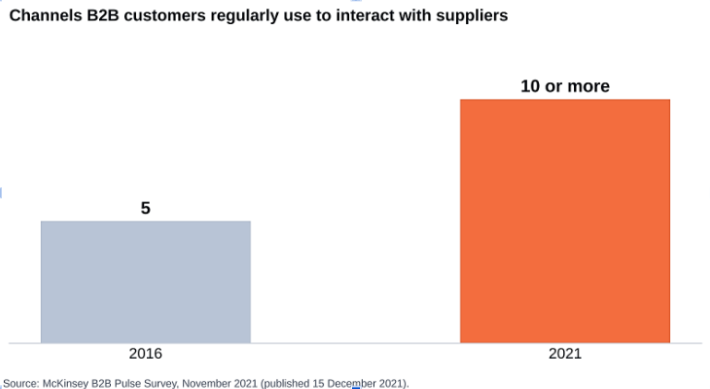
One system turns ten inboxes into one queue with one owner per lead
The survey covers B2B buying, so a consumer business should count its own channels. A service business can list its own: forms, calls, texts, chat, email and social messages. Any channel without a capture rule is a channel where leads vanish.What does a lead management system cost?
No approved source publishes a standard price, so cost is best read as a set of factors.Zapier advises weighing up-front costs, hidden costs and upgrades as the organization grows
Zapier's 2026 guide lists cost as one of four selection criteria, beside industry fit, scalability and user-friendliness. Lead management system cost has more than a license fee in it.| Factors that set the cost of a lead management system | |
|---|---|
| Factor | What to ask |
| Software | What the license covers, and how the price changes with users or features |
| Setup | Who audits, maps and builds the pipelines, and whether setup is a separate fee |
| Volume | Whether messages, contacts or automations carry usage charges |
| Upgrades | What the next tier adds and what it costs once the business grows |
| Staff time | Who reviews leak rate and updates the rules each week |
When do lead management services beat buying software alone?
Software supplies the tools, and services supply the design.Lead management services configure the software before it is used
Lead management services cover the audit, the lead map, the build and the weekly review. The Core package covers funnel setup, CRM pipeline setup, core follow-up automation and integrations. The Complete package adds fuller strategy, conversion mapping, AI follow-up and reactivation. Software alone fits a team with staff time to design and maintain the rules. Services fit a team without it. Funnel Gator's GoHighLevel CRM implementation guide shows how pipeline stages and lead scoring are set up in one platform.Who needs a lead management system, and who can wait?
The answer depends on the number of channels that bring inquiries and the number of people who reply to them.A business paying for leads or running two or more inbound channels needs a system now
Each channel adds a place for duplicates and missed replies. When the leads are paid for, a missed reply is money already spent.A solo operator with two or three inquiries a week can wait
One person with one inbox can answer them the same day without rules. A system becomes worth the effort when volume or headcount grows.
PRO TIP: Comparing tools comes second. Funnel Gator's lead management services start with an audit of where inquiries stall, so the system is chosen for the gaps that exist.
What should be checked about data and consent before choosing a system?
A system holds every lead's name, phone number and stated need, so the choice is also a data decision.Compliance requirements in industries such as finance and healthcare can limit which systems are options
Zapier's 2026 guide makes that point under industry fit. Four questions go to every vendor before signing.- Access: who can see lead records, and can access be removed when staff leave?
- Storage: where is lead data kept?
- Export: can records and consent history be exported?
- Consent: does each record store the date, source and wording of consent?
⚠ WARNING: Marketing and consent rules vary by place and by channel. This is not legal advice, so an attorney should review the consent wording a vendor stores before launch.
Final Verdict: A CRM Stores Leads and a System Moves Them
A lead management system is software plus written rules: capture every inquiry, qualify it, route it to a named owner, follow up and track the outcome. A CRM supplies the records, and the system supplies the motion. It suits any business that pays for leads or receives inquiries through more than one channel. The choice comes down to staff time: software alone fits a team that can maintain the rules, and services fit a team that cannot. Funnel Gator begins each build with a lead audit, because the right system depends on where leads stall and who owns them.Ready to Choose a System That Moves Leads? Book a Free Strategy Call With Funnel Gator
A short call covers where leads stall and what a system would change.- A map of lead sources, owners and the points where inquiries go cold
- A written response rule and fallback for every stage
- A system plan and quote that fit the CRM already in use