
Quick Answer: Lead management process is the set of steps that capture, qualify, route and follow up every inquiry until it becomes a customer or leaves the pipeline. In Zapier's 2026 guide, 92 percent of surveyed B2B teams dropped qualified leads at least monthly. A named owner and a time limit at each step prevent that.
A form submission lands at 4:40 p.m. on a Tuesday. The rep who normally replies is on a call, the shared inbox already holds a backlog, and nobody sees the new inquiry.
By Wednesday morning the prospect has heard back from a competitor. The ad that paid for the click shows one more lead, and no report shows the loss.
A lead management process exists to close that gap. It gives each inquiry an owner, a time limit and a next step before anyone has to remember them.
This blog post is about what the lead management system process is, the six steps with an owner for each, where leads get dropped, the routing and automation rules, B2B differences, three measurement formulas and data protection.
| Quick Summary: The Lead Management Process Overview | |
|---|---|
| Definition | The steps from first inquiry to sale: capture, clean, qualify, route, follow up and review. |
| Owner | One named person per step, with a written time limit and a fallback. |
| Dropped leads | 92 percent of surveyed B2B teams dropped qualified leads at least monthly (Zapier, 2026). |
| Routing | A named assignee, a first-contact time limit and a reassignment rule. |
| Measures | Response time, stage conversion and leak rate, reviewed weekly. |
| Security | NIST CSF 2.0 (2024) gives six Functions that apply to lead data in a CRM. |
What is the lead management process, and how does it differ from lead generation?
Two terms describe two different jobs.Lead management meaning: the work that starts when a lead enquires and ends at a sale or a closed record
Lead management meaning, in one line: every action taken on an inquiry after it exists. That covers logging it, judging it, assigning it, answering it and measuring what happened. Funnel Gator's lead management services set that work up in four weeks: a lead audit, lead mapping, system setup and optimization.Lead generation fills the pipeline, and the process decides how much of it converts
Lead management and lead generation are separate jobs. Generation produces inquiries through ads, search and referrals, and management handles each one afterward. Buying more leads before fixing the process raises the cost of each lead that actually gets an answer.What are the steps in the lead management process flow?
Six steps cover the path from first inquiry to weekly review.A six-step lead management process flow gives every inquiry one owner and one time limit
The lead management process flow below starts at capture and ends at a weekly review. Each step has one owner, one written rule and one failure it prevents.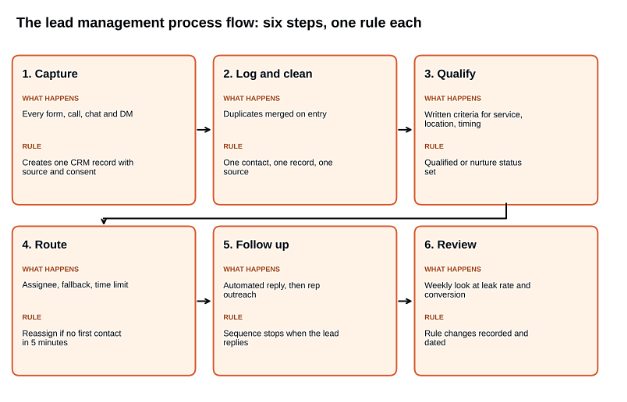
| Owner and failure point for each step of the lead management process | |||
|---|---|---|---|
| Step | Owner | Written rule | What breaks without it |
| 1. Capture | Marketing lead | Every form, call, chat and message creates one CRM record with source and consent | Inquiries sit in inboxes and spreadsheets |
| 2. Log and clean | CRM administrator | Duplicates merge on entry | Two reps contact the same person |
| 3. Qualify | Intake or sales rep | Written criteria for service, location and timing | Reps chase leads that cannot buy |
| 4. Route | Sales manager | Named assignee, fallback and time limit | Leads wait in a shared queue |
| 5. Follow up | Assigned rep | Automated reply first, rep outreach next, sequence stops on reply | Prospects hear nothing, or hear from three channels at once |
| 6. Review | Sales manager | Weekly check of leak rate and stage conversion | Rules never improve |
KEY TAKEAWAY: A step without a named owner and a time limit is a hope, not a process.
Where do leads get dropped in the lead management process?
Two published guides and one survey show where the process breaks.Zapier lists seven stages and HubSpot five, so six steps cover both lists without gaps
Zapier's 2026 lead management guide lists generation, qualification and segmentation, nurturing, scoring, distribution, conversion and tracking. HubSpot's 2026 guide lists capturing, qualifying, routing, nurturing and tracking.Zapier found that 92 percent of surveyed B2B teams dropped qualified leads at least monthly
The same survey found that 38 percent of teams lost multiple leads per week and 12 percent lost leads almost daily. The drops come from missing owners and missing time limits, not from a shortage of leads.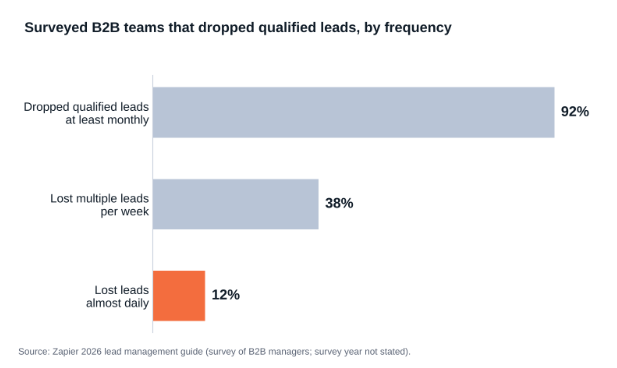
How do routing rules, CRM lead management and automation enforce the steps?
A written rule works only when the CRM applies it.Routing needs three parts: a named assignee, a time limit and a fallback
The assignee comes from a written criterion such as service type, location or territory. The time limit sets how fast the first contact must happen, and the fallback names who takes the lead when the limit passes. Zapier's guide describes round-robin routing and reassignment when a lead is not contacted within a set timeframe, which is that fallback in practice.CRM lead management names each stage after an action the customer took
Good CRM lead management uses stages such as form submitted, replied, booked and estimate sent. A stage named after a rep's impression, such as "warm", cannot be checked.Lead management automation runs on triggers when a record is created, changes stage or goes stale
GoHighLevel's help portal (2026) describes a Pipeline Stage Changed trigger that fires when an opportunity moves from one stage to another. It filters on assignee, tag, pipeline, lead value, stage and status. A separate Stale Opportunities trigger, covered in GoHighLevel's opportunity automation article, filters on no change for a set number of days.- Capture trigger: a submission creates the record, tags the source and starts the first reply.
- Stage trigger: a move to Estimate Sent starts the reminder sequence and notifies the owner.
- Stale trigger: no change for the set number of days reassigns the lead or moves it to nurture.
How does a B2B lead management process differ from a consumer one
The six steps stay the same, and the records change.A B2B lead management process links each contact to an account, so two reps never approach the same company
In a B2B lead management process, more than one contact at the same company can enquire separately, through forms, calls, email or chat. Each contact links to one account record and one owner. A consumer inquiry comes from one household, so the contact record alone is enough. Funnel Gator's case study shows how Apex Auto Care runs three separate pipelines for retail customers, dealer partners and collision centers in one CRM.How should the lead management process be measured?
Three formulas turn the process into numbers.Google Analytics defines a key event as an action that matters to the success of a business
Google's Analytics documentation defines a key event as an event that measures an action particularly important to the success of a business, and notes that a Google Ads conversion can be created from one. For lead management, a submitted form and a booked appointment are key events.- Response time: time of first human contact minus time of the inquiry.
- Stage conversion: leads entering the next stage divided by leads entering this stage.
- Leak rate: leads with no logged follow-up divided by all leads.
Who needs a documented lead management process, and who should run it?
Headcount and inquiry sources decide both questions.A business that cannot say who contacted a lead last, and when, needs a documented process now
Two lead sources create duplicates. A second person replying creates conflicting messages. Paid leads turn every missed reply into a direct cost. A solo operator with two or three inquiries a week can answer each one the same day and wait.A team can run the process in-house, or hand it to lead management services or a lead management company
In-house work needs one person who owns the weekly review. Lead management services build the process once and hand it over, while a lead management company builds it and keeps running it. Either way, the process runs inside a lead management system, which is the software that applies the owners, time limits and triggers.
PRO TIP: A lead audit shows where inquiries stall before any rule is written. Funnel Gator's lead management services begin with that audit.
How should the lead management process protect lead data and consent?
A lead record holds a name, a phone number and a stated need, so it needs the same protection as any customer data.NIST CSF 2.0 gives six Functions that apply to lead data: Govern, Identify, Protect, Detect, Respond and Recover
The NIST Cybersecurity Framework 2.0, published in February 2024, is designed for organizations of all sizes and sectors. Applied to lead data, each Function becomes a task.- Govern: one named owner for lead data and access rules.
- Identify: a list of every place leads are stored, including inboxes and spreadsheets.
- Protect: role-based CRM access, and removal of access when staff leave.
- Detect: alerts for unusual exports or logins.
- Respond and Recover: a written breach plan and a tested way to restore records.
Consent belongs on the lead record, with the date, the source and the wording shown
Calls, texts and email carry separate legal rules that vary by country and state. Recording consent at capture gives every later message a documented basis.
⚠ WARNING: Consent and marketing laws differ by place and by channel. This is not legal advice, so have an attorney review consent language and follow-up sequences before launch.
Final Verdict: Give Every Lead an Owner and a Clock
A lead management process works when every step has a named owner, a written rule and a time limit. Capture everything into one record, qualify against written criteria, route with a fallback, automate the first reply and review leak rate every week. Each rule fits on one page, and each can change once the weekly review shows where leads stall. It suits any business that pays for leads or has more than one person answering them. The quickest start is a one-page list of owners and time limits, and the team at Funnel Gator can turn that list into a working pipeline inside GoHighLevel.Ready to Fix What Happens After a Lead Enquires? Book a Free Strategy Call With Funnel Gator
A short call covers where leads stall and what to fix first.- A map of lead sources, owners and the points where inquiries go cold
- A written response rule and fallback for every step
- A CRM setup plan that fits the platform already in use